
I will be honest with you. Taking Apple on a train was not the plan.
We had driven to Pune for a work trip and Apple came along because Apple always comes along. The drive back to Delhi is 1,500 kilometres and we were looking at a 17-hour road journey with a dog who had already done two long drives that month and was, frankly, tired of the back seat.
Akash said: what about the train.
I said: what about the train?
Neither of us had done this before. But we had been getting questions about it for months, from our community, from DMs, from people who had watched us drive to Jim Corbett and Rishikesh and Bhimtal and wanted to know if the train was a real option. So we decided to find out properly, the only way we actually trust: by doing it ourselves.
We booked Goa Express 12780 from Pune to Delhi. First AC.
What followed was one of the best journeys we have ever had with Apple, and also the most instructive.
Why the Goa Express and why First AC
The Goa Express runs from Vasco Da Gama to Hazrat Nizamuddin. The Pune to Delhi segment is roughly 27 hours. For a journey that long with a large dog, First AC is not a luxury. It is the only class where the rules actually permit your dog to be with you.
Indian Railways allows dogs in exactly two ways on a train. The first is the dog box in the brake van, which is the SLR coach at the back. Your dog travels separated from you, in a crate, in what is essentially a luggage compartment. For a calm adult dog on a short journey in good weather, this works. For Apple, who is 5 years old, large, and accustomed to being near us, we were not doing the brake van option for a 27-hour overnight journey.
The second way is First AC, 1A class, with the entire coupe booked under one PNR. This is what we did.
The key rule that nobody explains clearly enough: you are not just buying a ticket in First AC. You are booking the entire enclosed compartment. The 2-berth coupe or the 4-berth cabin. All of it. Under your name. This is because Indian Railways cannot seat another passenger next to your dog without their consent, and they have no way to guarantee that consent at booking time. So the solution is: you take the whole space.
The Goa Express has First AC coaches. Many popular trains on the Delhi to hill-station routes do not. Always check the coach composition on IRCTC before deciding your train.
The booking process, from start to finish
This is where most people get confused, because it is not a single transaction.
Step 1: Book your own tickets first.
We booked for two of us in First AC, one PNR. At this stage you are just buying berths for yourself. The dog booking comes later.
Step 2: Request the coupe allocation.
This is the step that is not obvious and that nobody warns you about clearly. After your tickets are confirmed, you need to contact the Chief Reservation Supervisor at your originating station and request that your PNR be allocated an entire coupe or cabin. Without this, another passenger could be assigned to the remaining berths of your compartment.
At Pune station, we went to the Chief Reservation Supervisor's office in person. Showed the PNR, explained we were travelling with a large dog in First AC, requested the enclosed coupe. They noted it and said it would be reflected in the final chart. We verified this on the chart when it was published before departure.
Step 3: Book the dog on IRCTC.
Once the first chart is prepared (usually 4 to 6 hours before departure), log in to IRCTC and look for the Dogs/Cats option under the booking section. You book the dog against your existing PNR. There is a charge based on distance and the weight classification: for First AC dog travel, you are charged at the 60 kg luggage rate regardless of your dog's actual weight. For our Pune to Delhi journey this was a modest amount, not expensive relative to the ticket cost.
One important note: only one pet is allowed per PNR.
Step 4: Get to the station early.
We reached Pune station three hours before departure. That sounds like a lot. It is the right amount. There is a physical booking process at the parcel office that cannot be done online in advance for some documentation. We got Apple's travel entry stamped at the luggage counter. We also needed the platform pass for Apple, which required showing the vaccination certificate and IRCTC booking confirmation.
What we carried
The train is not a car. You cannot stop when you want to. You cannot open the window at any speed. Plan as if you are going to a small apartment for 27 hours.
Water, more than you think. Apple drank more than usual on the train, probably from mild travel stress and the air conditioning. We carried 6 litres and used most of it. Collapsible silicone bowls are the right format for a train. Hard bowls roll off the seat at every sway.
His mat. Apple has a specific mat that smells like home. We rolled it out on the lower berth and he settled on it within 20 minutes. The familiar smell helps more than any supplement we have tried.
Food, but timed carefully. We gave Apple a light meal 3 hours before boarding. Nothing during the first 4 hours of travel. Motion sickness in dogs is real, more common than people realise, and a full stomach makes it worse. By the second half of the journey when he was clearly relaxed, we gave him his normal dinner on the berth.
Poop bags and newspaper. Station stops on the Goa Express are frequent enough. We took Apple off at 3 stops during the 27 hours for a walk and a toilet break. Having the newspaper as a floor covering for the coupe gave us peace of mind.
His vaccination records and the fit-to-travel certificate. We had the vet issue a fitness-to-travel certificate 48 hours before departure. Rabies vaccination confirmed, all core vaccines up to date. The documentation was checked at the platform and again at the luggage counter.
His muzzle. Indian Railways requires large dogs to wear a muzzle on platforms and in the train. Apple is accustomed to wearing his muzzle at home so this was not distressing for him. If your dog has never worn a muzzle before, practice at home for at least a week before the journey. A dog in a muzzle for the first time on a crowded platform is a difficult situation.
What actually happened on the train
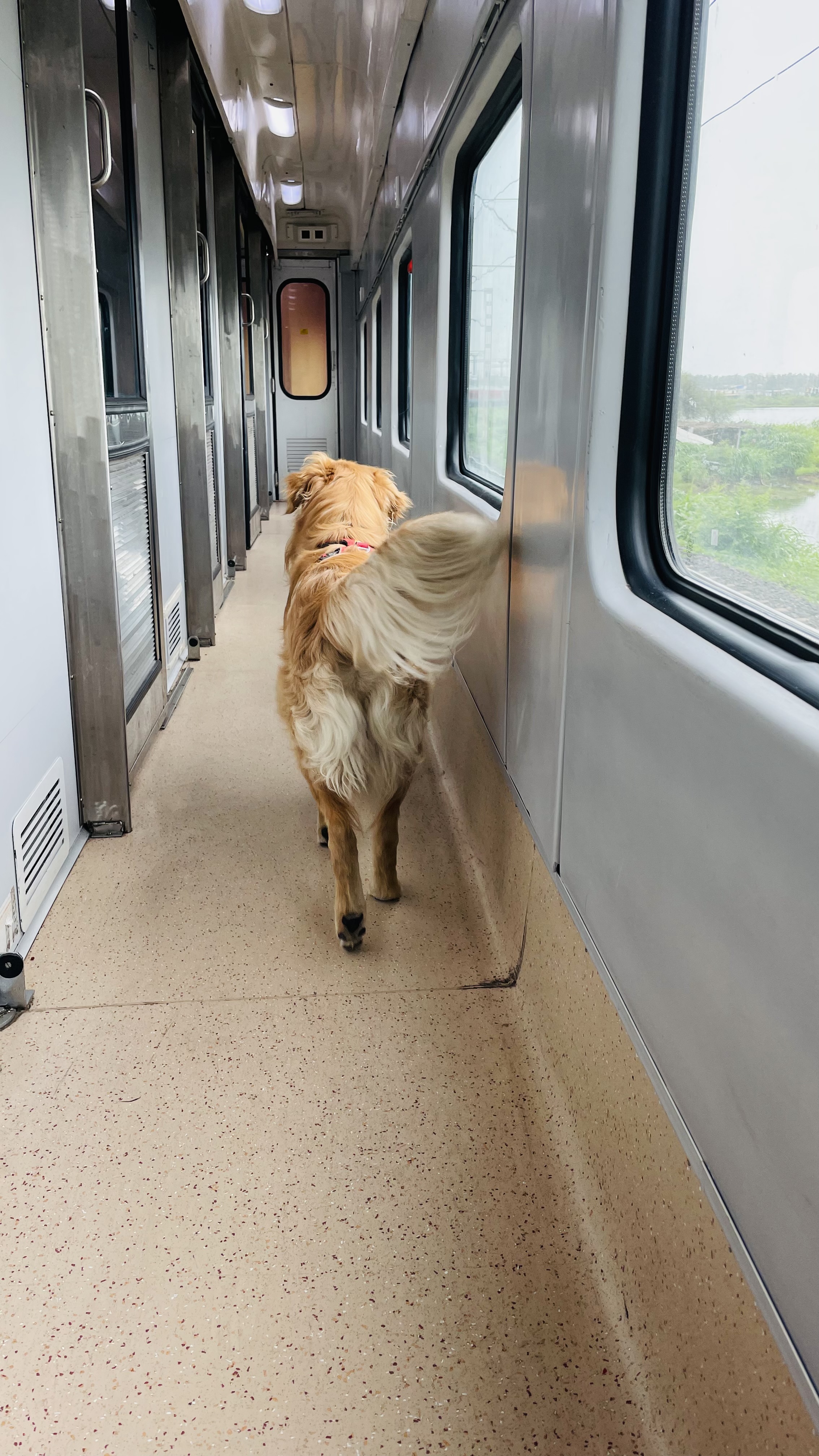
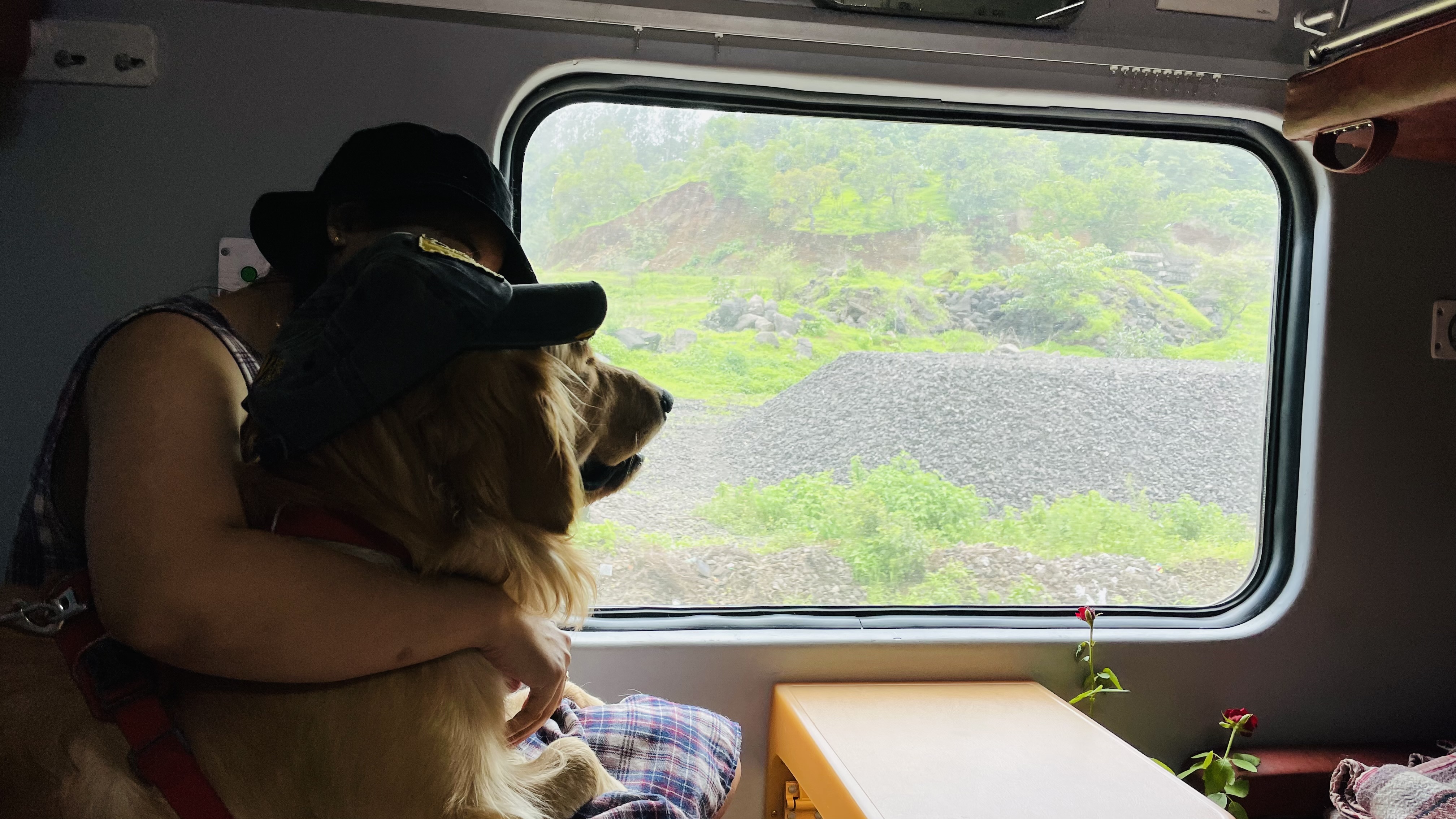
Apple settled into the coupe within the first hour. He chose the lower berth by the window, which should surprise nobody who knows him. He spent the first two hours watching the Deccan Plateau roll past with complete focus. By evening he was horizontal and asleep.
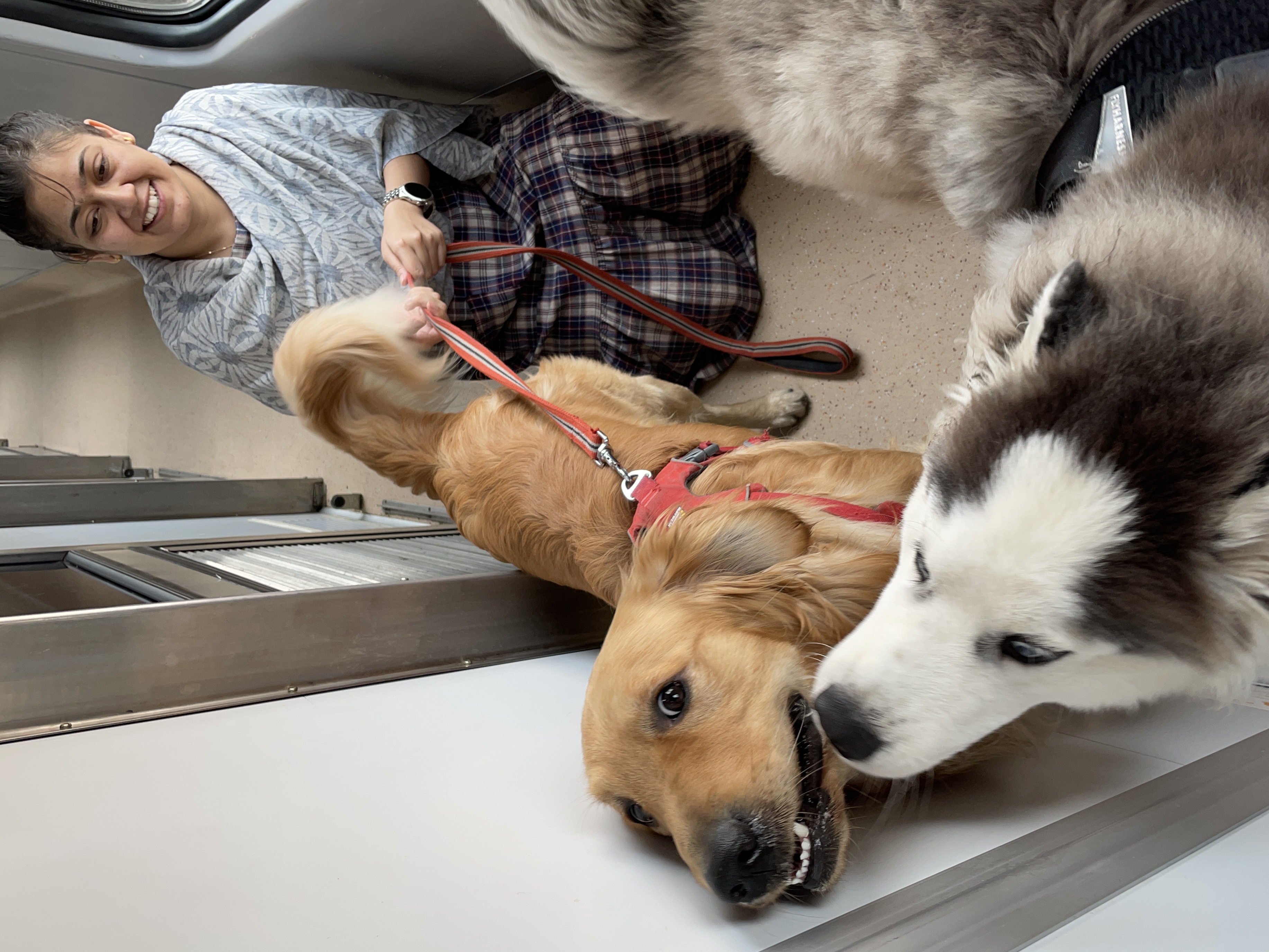
We had the coupe to ourselves for the first part of the journey. Then at a mid-journey stop, the door opened and a family boarded with a Husky. A white Siberian Husky, young, clearly well-socialised. They had booked the adjacent coupe in First AC for the same reason we had.
For about 20 minutes the Husky was extremely interested in the door between the coupes and Apple was extremely interested in the window. Then something shifted. The Husky calmed. Apple looked over. They spent the rest of the night with their respective heads at the bottom of their respective doors, aware of each other, unbothered.
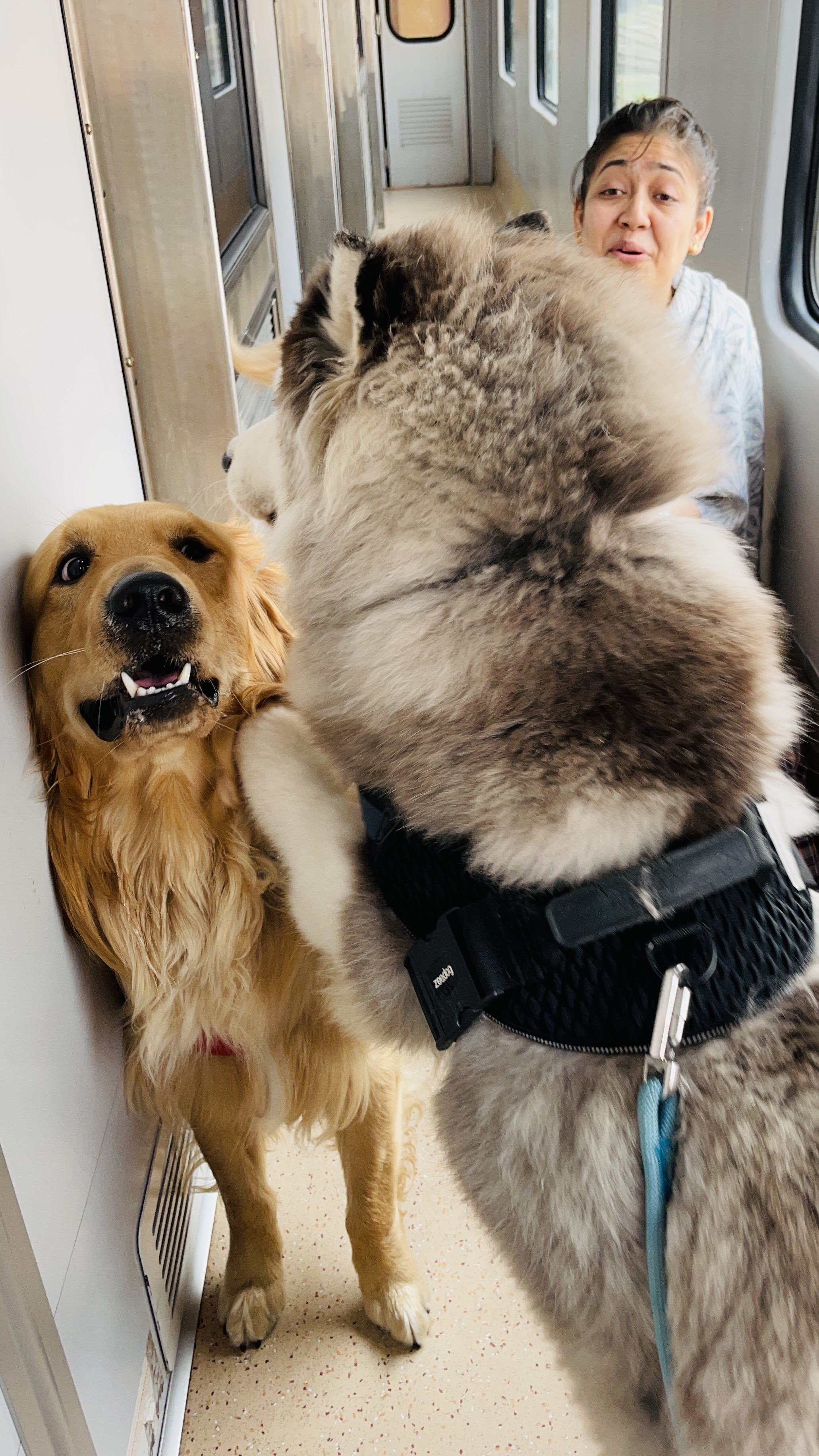
The family was travelling from Pune to Hazrat Nizamuddin as well. We shared station stop information across the corridor, told each other which platform ends had more walking space, and compared notes on the coupe allocation process at Pune. Their experience had been almost identical to ours, including the visit to the Chief Reservation Supervisor's office.
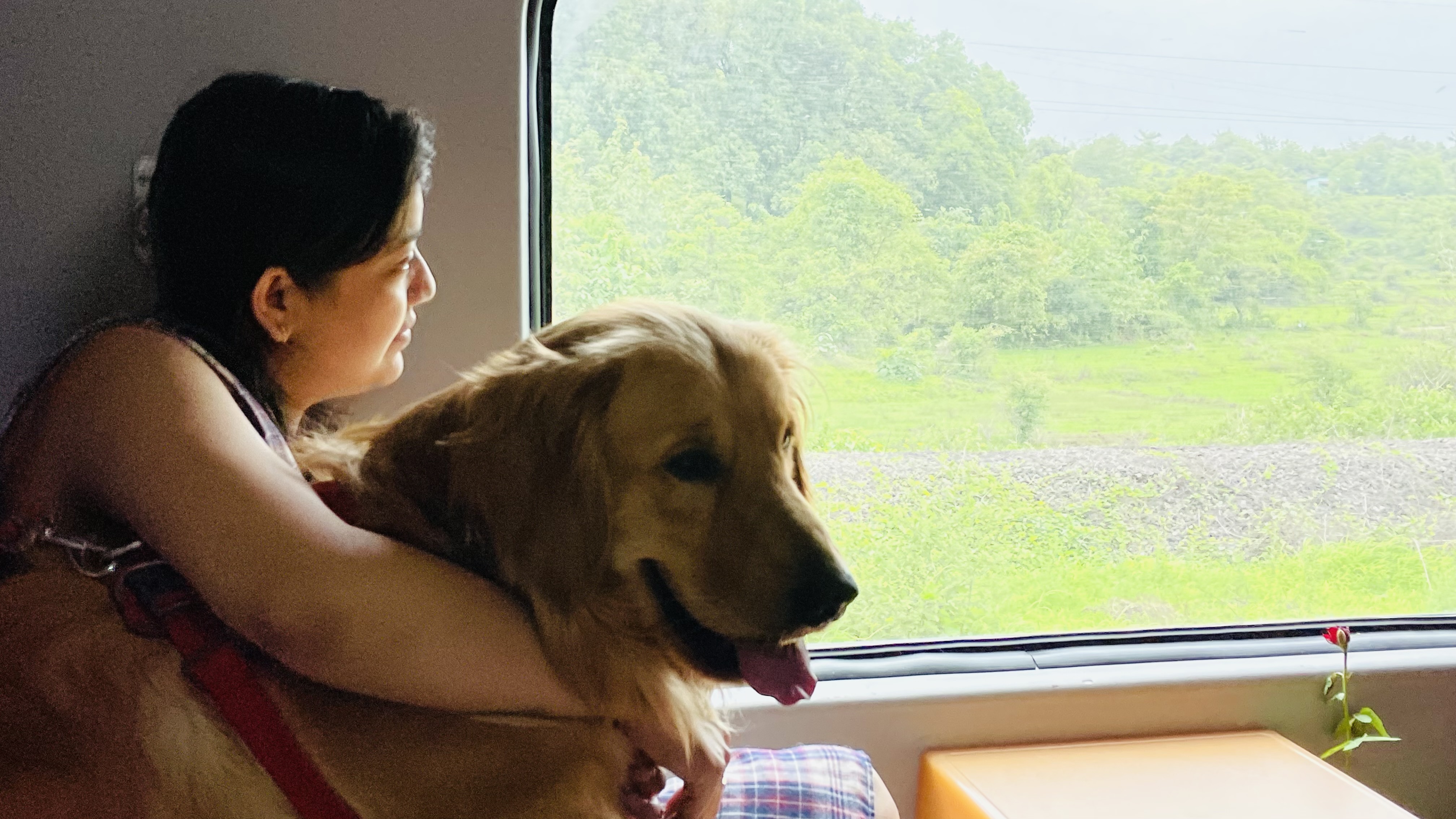
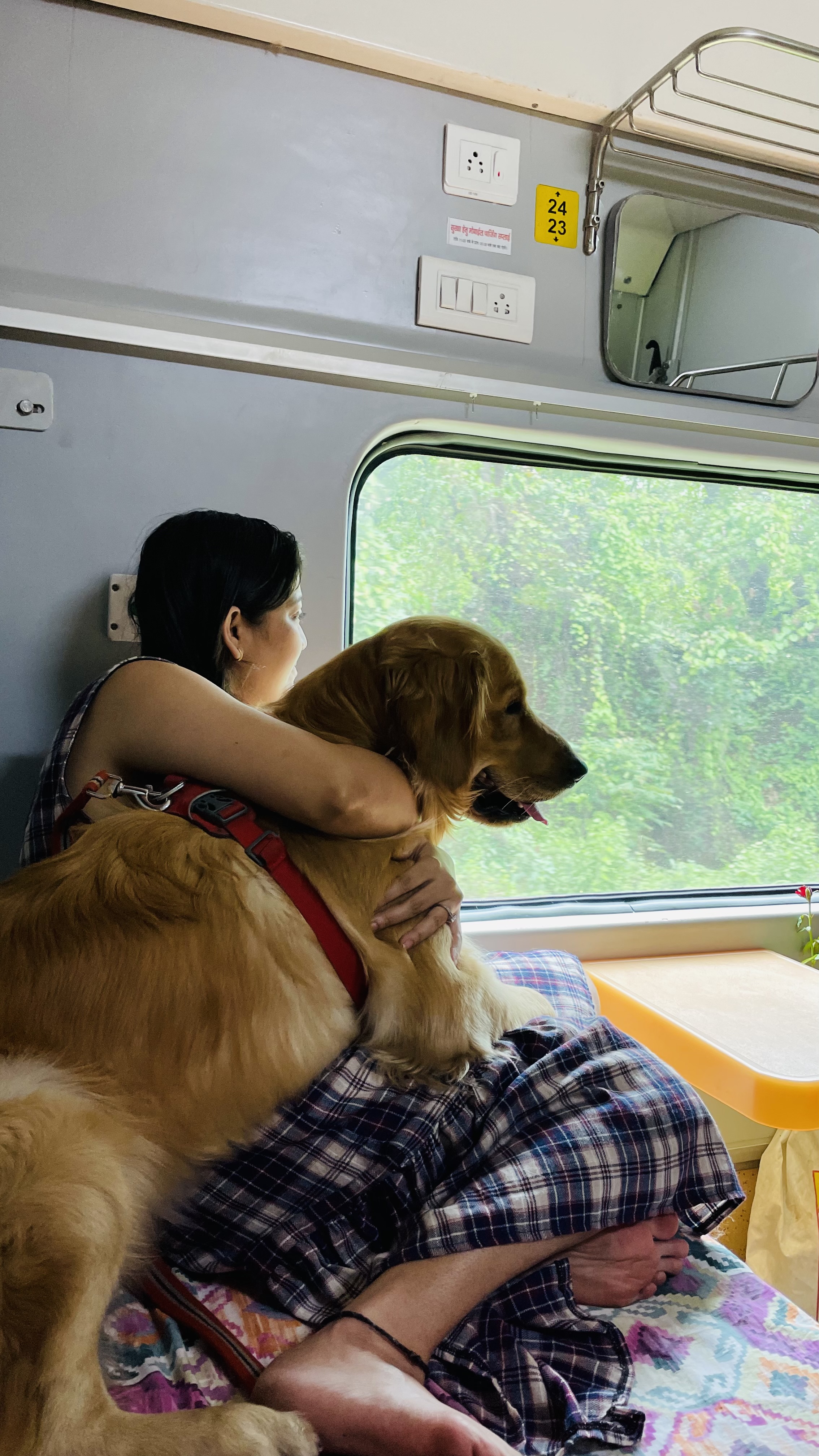
By morning Apple had moved from the lower berth to my lap, which is where he appears in the photograph. He was watching the green Madhya Pradesh countryside with the same expression he uses when he spots a lake from the Rubicon and wants me to pull over immediately.
What we wish someone had told us
The booking process is in two parts and the second part, the IRCTC pet booking, can only be done a few hours before departure. If you do not know this, you might assume that confirming your own ticket means the dog is sorted. It does not. The dog needs a separate booking entry on the same PNR.
Not all First AC coaches are equal. Some older 1A coaches on certain trains have coupes that are genuinely small. The Goa Express 12780 has comfortable First AC coaches. Check reviews of the specific train, not just the class.
The chart confirmation matters. Verify your coupe allocation when the chart is published, ideally the night before. If there is a discrepancy, the Chief Reservation Supervisor can often resolve it at the station before departure.
Platform crowds and the muzzle rule are both real. Apple is comfortable on crowded platforms because we have taken him to markets and stations before. A dog who has never been on a busy platform will find Pune station overwhelming. The muzzle requirement is enforced, at least at Pune. Do not assume you can skip it.
Station stops are your only outdoor time. Know which stops have more than 5 minutes and plan for those. On the Goa Express the longer stops gave us enough time for a walk, water, and a toilet break.
The honest verdict
We drove back from Pune to Delhi the next time because we had all three dogs and the logistics of the coupe for three large dogs and two adults required a full 4-berth cabin booking, which was not available on the dates we needed.
For one or two dogs, the First AC coupe option on the Goa Express or any train with a good 1A coach is genuinely excellent. Apple was calmer on the train than on the longest road journeys we have done. The enclosed coupe, the consistent temperature, the rhythm of the train, all of it suited him.
The paperwork is not as difficult as it sounds. The coupe allocation request is the step that is least documented online and most important to get right. Everything else is standard.
If you are planning a train journey with your dog in India and have questions about the booking process, the Tails Community Travel and Road Trips section has threads from people who have done this and share what actually happened at their specific stations. That thread is more useful than any guide, including this one.
How to book: the complete checklist
- Check that your chosen train has a First AC (1A) coach in its composition. Not all trains do.
- Book your own tickets in First AC under one PNR. Two passengers for a coupe, four for a cabin.
- Visit the Chief Reservation Supervisor at the originating station to request coupe allocation to your PNR. Do this as early as possible, ideally at least 2 to 3 days before travel.
- Get a veterinary fitness-to-travel certificate within 48 hours of departure. Carry vaccination records. Rabies vaccination is mandatory and will be checked.
- Accustom your dog to wearing a muzzle before the journey. The muzzle rule is enforced on platforms and in the train for large dogs.
- After the first chart is prepared (4 to 6 hours before departure), book your dog on IRCTC under the Dogs/Cats option against your PNR. Pay the charge. Print or save the confirmation.
- Reach the station at least 3 hours before departure. Complete the luggage counter documentation. Get the platform pass for your dog.
- Carry enough water for the full journey. Plan meals around the travel schedule. Bring a familiar mat or blanket.
- Know the station stops in advance and use them. Your dog's only outdoor time is at stations.
FAQ
Can I take my dog on the Goa Express?
Yes. The Goa Express 12780 has First AC coaches and allows dogs when you book the entire coupe under one PNR. The same rules apply as on any Indian Railways train with a 1A coach. We took Apple, our Golden Retriever, from Pune to Delhi on this train.
How much does it cost to travel with a dog in First AC on Indian Railways?
Your own First AC tickets are the main cost, priced by distance. The dog booking on IRCTC is charged at the 60 kg luggage rate for First AC travel, regardless of the dog's actual weight. For a Pune to Delhi distance this is a modest additional charge.
Which trains allow dogs in the cabin in India?
Any train with a First AC (1A) coach allows dogs in the cabin, provided you book the entire coupe or cabin under one PNR. Check the coach composition of your specific train on IRCTC before booking. Popular hill-station routes from Delhi often do not have 1A coaches.
Can I take a large dog on an Indian train?
Yes. There is no breed restriction and no specific weight restriction for dogs in First AC travel. Large dogs including Golden Retrievers, Labradors, and Huskies have all done this journey. A muzzle is required for large dogs on platforms and in the train.
What documents do I need to travel with my dog by train in India?
Your own PNR tickets, the IRCTC dog booking confirmation, the dog's vaccination certificate with rabies clearly mentioned, a veterinary fitness-to-travel certificate issued within 48 hours of departure, and a muzzle for large dogs. Carry all original documents.
Is the IRCTC dog booking available online?
Yes, the dog booking can be done online through IRCTC after the first chart is prepared, usually 4 to 6 hours before departure. The pet booking section appears under the booking details for your confirmed PNR. Note that this is separate from your own ticket booking and must be done as an additional step.
Apple spent most of those 27 hours in my lap or on his mat by the window. He watched the countryside with the same calm attention he brings to everything that interests him, which is most things when moving at speed with fields outside. The Husky in the adjacent coupe kept him mildly interested through the night. By the time we pulled into Hazrat Nizamuddin he was rested and I was convinced this was the right way to move a large dog across a long distance in India.
The Rubicon is still the answer when we have all three dogs. But for Apple and a journey that long, the train won.
Ekta, Apple, Captain, Kimchi and Akash